PodEcho
An AI podcast digest service — subscribe to your favorite podcasts and creators, and get every new episode as a digest email you can read in minutes.
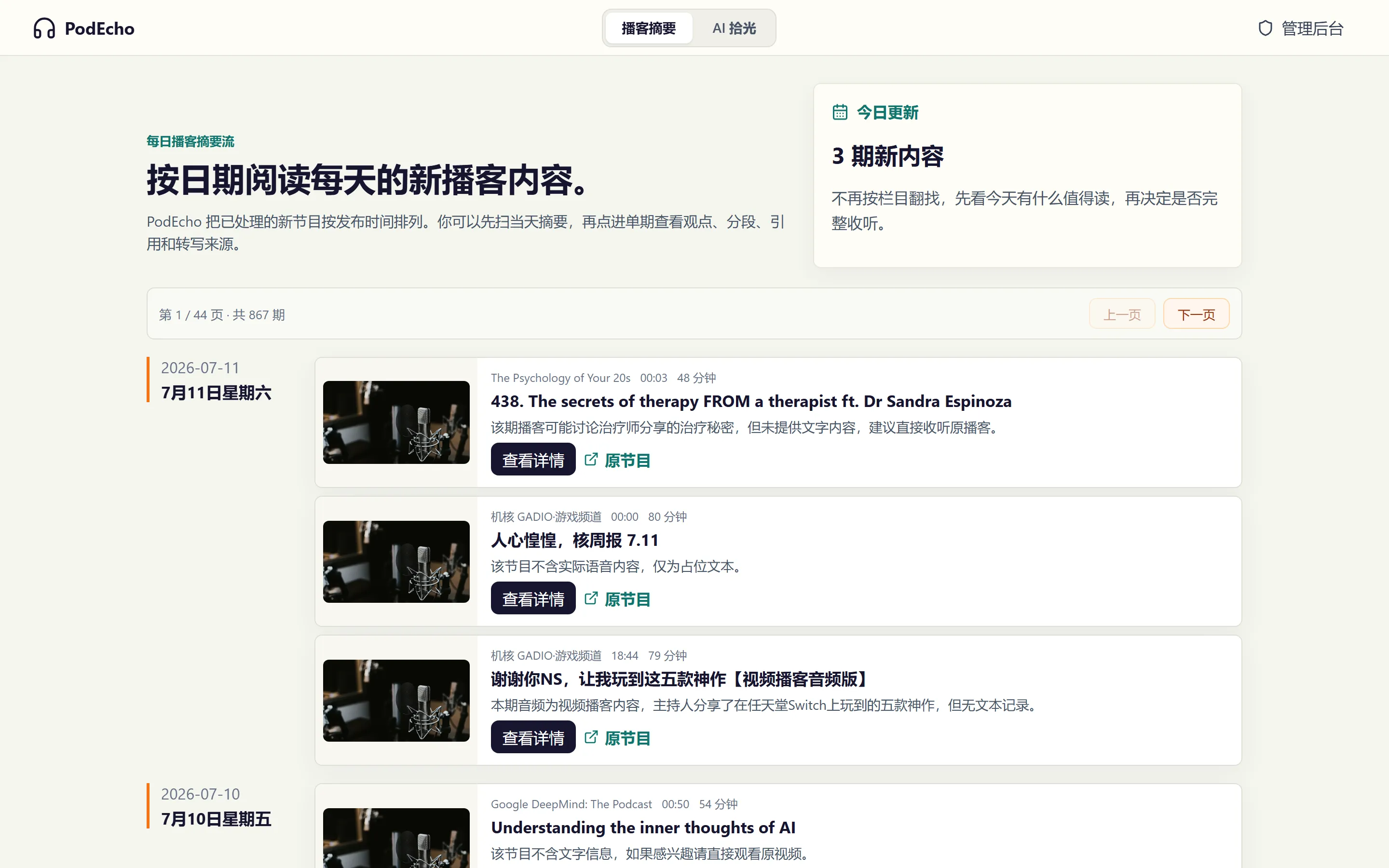
Good podcasts run two or three hours an episode — you bookmark plenty and finish few. PodEcho condenses them first: subscribe to the podcasts and creators you follow, and every day it watches for updates and turns each new episode into a digest email you can read in minutes — a one-line takeaway, the key points, a sectioned walkthrough, highlighted quotes from the transcript, and a verdict on whether the full episode is worth your time.
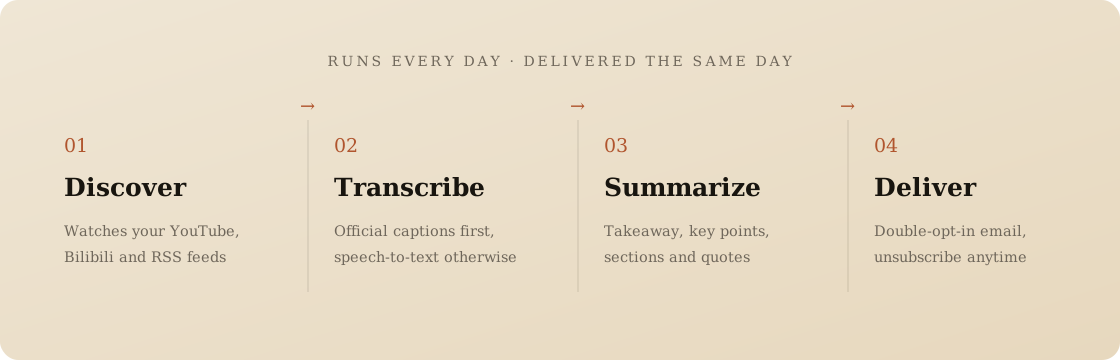
The experience is designed to be low-noise and trustworthy: subscriptions require double opt-in email confirmation, so nobody can sign you up without consent; every email carries one-click unsubscribe; and every quote in a digest comes from the real transcript — the AI is never allowed to invent one. Episodes with official captions use them directly; everything else goes through automatic speech-to-text, so both video and audio-only podcasts are covered.
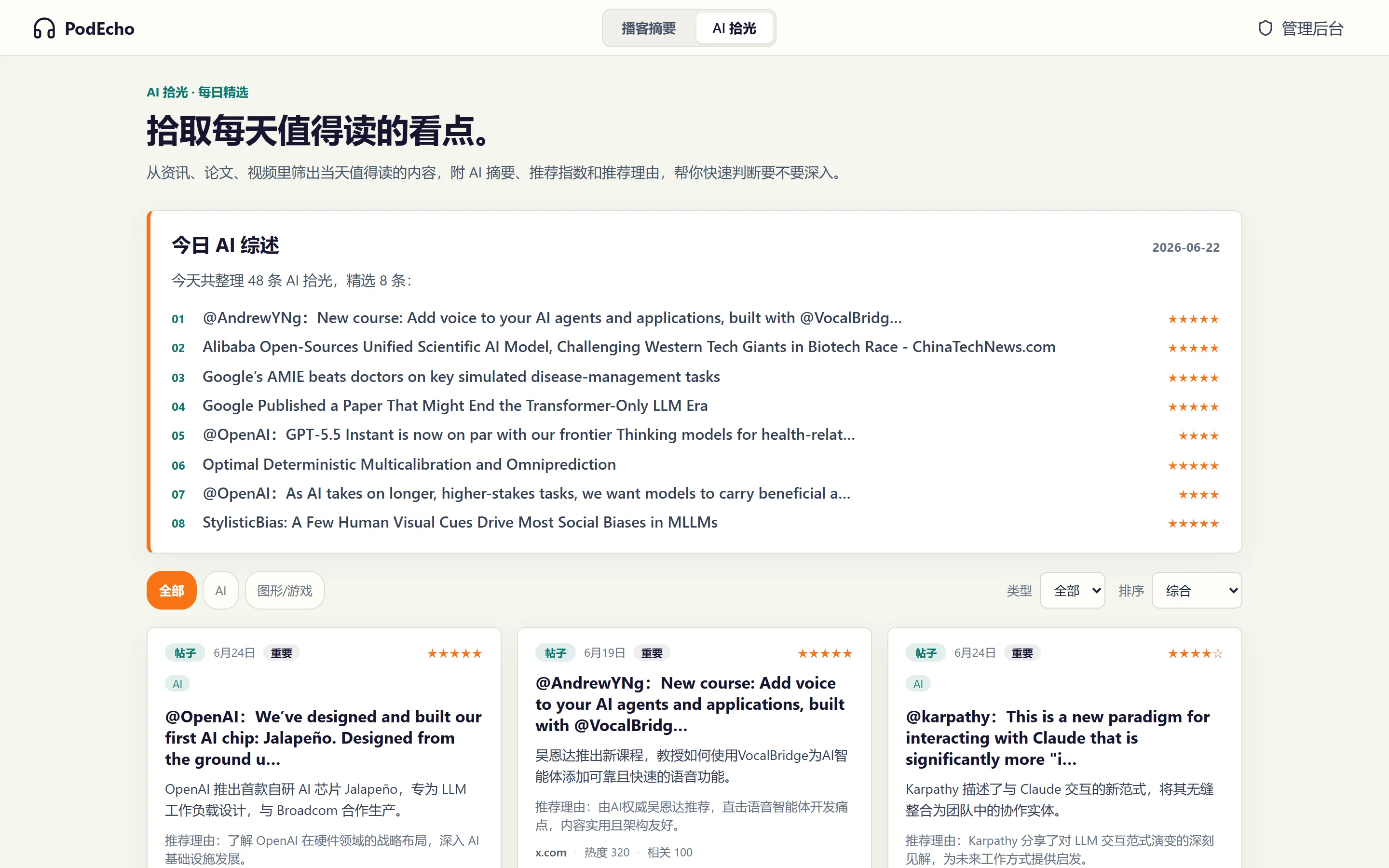
Beyond podcasts there’s a second board, AI Picks: every day it trawls news feeds, papers (arXiv), Hacker News, Reddit and video platforms for AI-related content, has the AI summarize and relevance-score each item, and keeps only the handful actually worth reading that day — each with a rating and a one-line reason to read. It runs on its own domain model, separate from the podcast pipeline, while reusing the same budget, cost-tracking and security infrastructure.
Technical highlights
Under the hood it's an automated backend pipeline, engineered around four concerns.
Reliable
Every job carries a unique key — failures retry automatically, and a retry can never double-send an email; stuck jobs are recovered, and permanently failed ones land in a review queue for one-click retry.
Pluggable
The five external services — AI summarization, speech-to-text, email, RSS, video sources — all live behind interfaces; fake implementations run the whole loop locally at zero cost, and swapping vendors is a one-line config change.
Secure
External fetches go through SSRF protection with timeouts and size caps; subscription tokens are stored hashed; transcripts and titles are treated as untrusted input against prompt injection; AI output passes schema validation and escaping before reaching an email.
Cost-aware
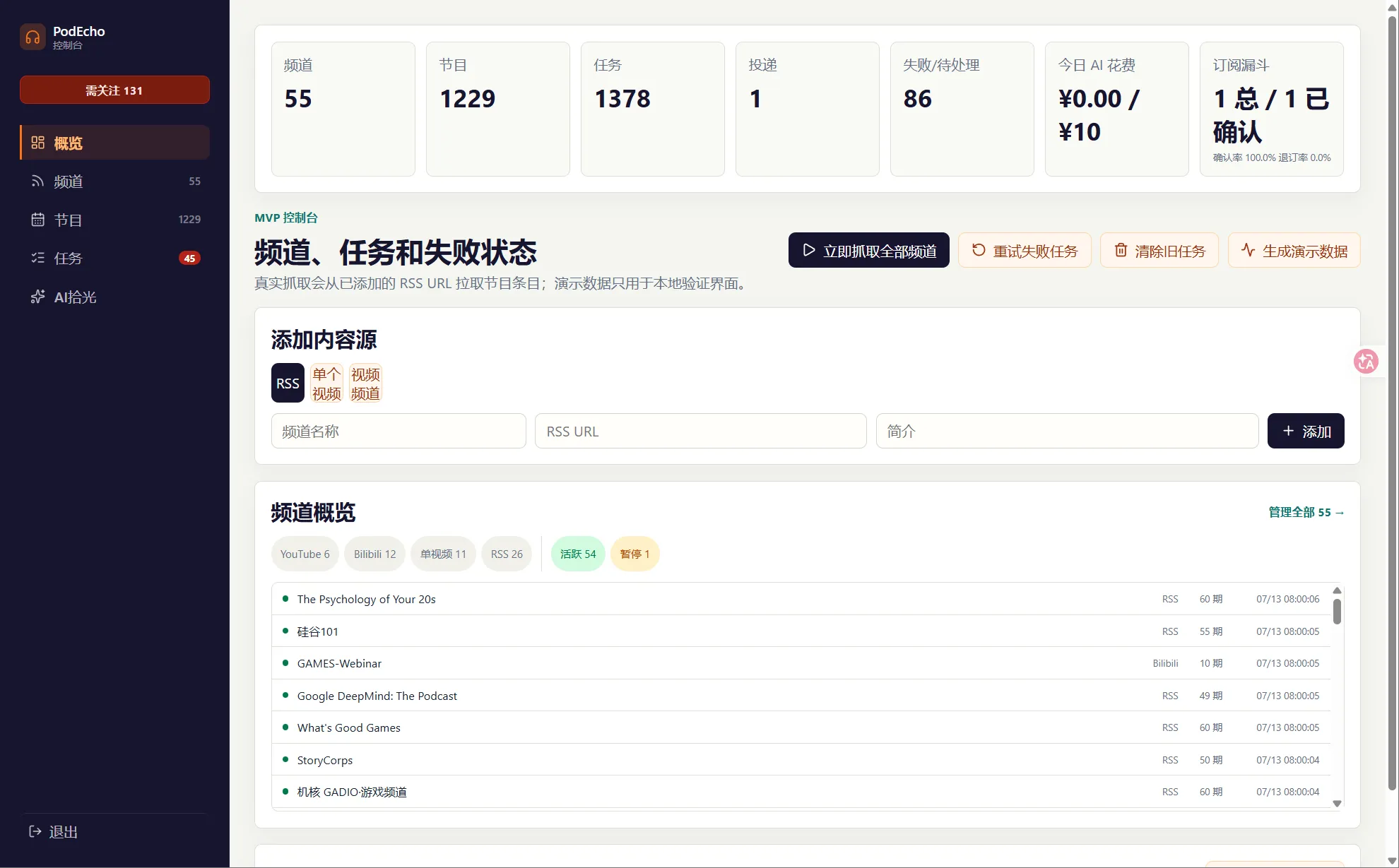
Every AI call is metered for tokens and estimated cost; once the daily budget is hit, new jobs gracefully roll over to the next day instead of being dropped.
A claimed defense must become a verified defense — injection resistance isn’t a line in the README, it’s a test that always runs in CI.